
Categories
ADU in Snoqualmie Valley, ADU North Bend, ADU Snoqualmie, DADU in Snoqualmie Valley, DADU North Bend, DADU Snoqualmie, Real Estate in Fall City, Real Estate in North Bend WA, Real Estate in Snoqualmie, Real Estate in Snoqualmie ValleyPublished July 1, 2026
ADU vs DADU - what is the difference?

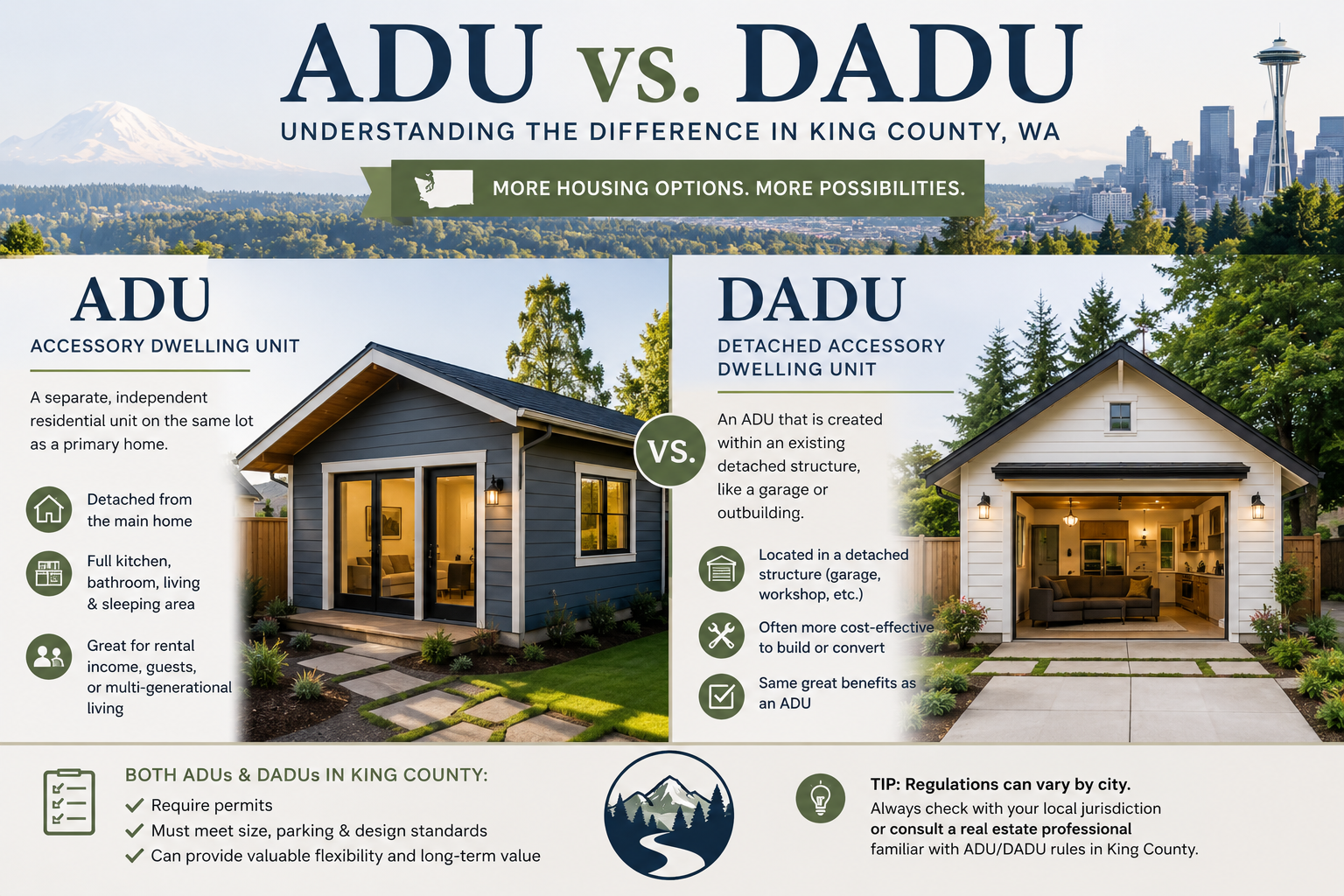
ADU vs. DADU in King County:
What Snoqualmie Valley Homeowners Need to Know
The rules are different in North Bend than they are in Fall City — and both are different from the City of Snoqualmie. Here's your hyper-local guide to accessory dwelling units in the Upper Valley, updated for 2025 and beyond.
If you own property in the Snoqualmie Valley — or you're considering buying here — understanding the distinction between an ADU and a DADU isn't just a vocabulary exercise. It directly affects what you can build, how large it can be, how close it can sit to your property lines, how it gets permitted, and whether it's feasible at all on your particular parcel.
These questions come up constantly in my practice. A seller wants to know if their property could support a rental cottage before they list. A buyer wants to know if they can house aging parents on the same lot. An investor wants to understand what their income potential looks like after closing. And in every case, the answer begins the same way: what jurisdiction are you in?
Because the rules in the City of North Bend are not the same as the rules in the City of Snoqualmie. And the rules for Fall City — which is not a city but an unincorporated community governed by King County — are different from both.
Homeownership is out of reach for approximately 75% of Washington families. ADUs and DADUs are one of the few tools that let existing property owners meaningfully participate in the solution.
Why This Matters Right Now: The Housing Crisis Context
Washington State is in the middle of a housing affordability crisis that is not abstract — it shows up in real ways for real families in the Snoqualmie Valley. The average income required to qualify for a median-priced Washington State home is nearly $176,000 per year, while the average Washington household earns roughly $94,600. Put plainly, homeownership is out of reach for approximately 75% of Washington families based on current prices and lending standards.
The state has set a goal of 1.1 million new homes over the next two decades. And one of the most immediate, practical tools available to existing homeowners is the ADU — small, relatively affordable to build, and possible to develop without buying additional land. ADU permitting statewide has been climbing steadily since 2020, and legislative changes enacted in 2023 are accelerating that trend.
75%
of WA families for whom homeownership is unaffordable at current prices
1.1M
new homes Washington State needs over the next 20 years
2
ADUs now allowed per residential lot in urban growth areas under HB 1337
50%
cap on ADU impact fees relative to primary home under HB 1337
The Game-Changer: Washington's House Bill 1337
In 2023, the Washington State Legislature passed House Bill 1337 — one of the most significant changes to residential land use law in the state's recent history. For King County, the changes took effect by June 30, 2025. If you haven't updated your understanding of ADU rules since before that date, you may be working with outdated information.
Here is what HB 1337 requires statewide for all jurisdictions within Urban Growth Areas:
- Cities and counties must allow at least two ADUs per residential lot in all areas where single-family homes are permitted. This can be two attached, two detached, or one of each.
- The maximum ADU size must be at least 1,000 square feet. Local governments can no longer cap ADUs smaller than that floor.
- Owner occupancy requirements are eliminated. You can rent both your primary home and your ADU or DADU independently. No annual affidavit required.
- Impact fees are capped at 50% of what would be charged for the primary residence. For ADUs under 750 square feet, fees may be further reduced or waived.
- No parking requirements may be imposed for ADUs, with limited exceptions.
- Existing structures — including garages — may be converted into ADUs regardless of current setback or lot coverage nonconformities.
- ADUs may be sold separately from the primary home as condominiums, opening a new avenue for property owners to monetize or transfer these units independently.
- Cities must approve compliant ADU applications within 60 days, streamlining what was often an unpredictable permitting timeline.
Important nuance: HB 1337 applies to properties within Urban Growth Areas. Properties in rural zones outside the UGA — which includes much of the Snoqualmie Valley's acreage — are not subject to all of the same requirements. Rural ADU rules remain more restrictive. This distinction is particularly important for Fall City and rural parcels in the upper valley.
Jurisdiction First: The Question That Changes Everything
Before you spend a dollar on plans or consult a contractor, you must answer one question: what jurisdiction is your property in? In the Snoqualmie Valley, there are three distinct answers, each with its own rulebook.
City of North Bend
An incorporated city with its own municipal code (NBMC). Permitted through the City of North Bend's Community Development department. Updated its ADU regulations via Ordinance 1825 in 2025 to comply with HB 1337. Urban residential lots apply city-specific rules.
City of Snoqualmie
An incorporated city with its own code. Has been updating its regulations to comply with HB 1337. Different size limits, setbacks, and parking rules than North Bend. Permitted through the City of Snoqualmie's permit office.
Fall City & Rural Unincorporated King County
Fall City is not a city. It is an unincorporated community governed by King County. The same applies to many rural parcels throughout the upper valley. These properties are permitted through King County's Department of Local Services — and the rules differ meaningfully from either incorporated city.
How to Check Your Jurisdiction
Use the King County Parcel Viewer at parcelviewer.kingcounty.gov and enter your address. The jurisdiction field will confirm whether you are in an incorporated city or unincorporated King County. This step is non-negotiable before planning any ADU project.
Side-by-Side: How the Rules Compare
The table below reflects current regulations as of mid-2025, following HB 1337 implementation. Always verify with the applicable jurisdiction before proceeding — codes are actively evolving and individual parcels may carry additional constraints tied to critical areas, septic, or zoning overlays.
| Rule / Standard | Unincorporated King County (including Fall City) |
City of North Bend | City of Snoqualmie |
|---|---|---|---|
| Governing body | King County Dept. of Local Services | City of North Bend (NBMC) | City of Snoqualmie |
| ADUs allowed per lot (urban/UGA) | Up to 2 (per HB 1337 in UGA zones) | Up to 2 (per Ord. 1825, 2025) | Up to 2 (per HB 1337) |
| ADUs allowed per lot (rural/outside UGA) | 1 only | N/A (city is urban) | N/A (city is urban) |
| Max DADU size (heated) | 1,000 sq ft heated + 1,000 sq ft unheated Basement sq ft excluded from count |
1,000 sq ft Entire floor/level may exceed limit if occupying full floor |
1,000 sq ft (per HB 1337 floor) |
| Minimum lot size for DADU | 3,200 sq ft (urban zones) RA-2.5: 2.5 acres min. RA-5: 5 acres min. RA-10: 5 acres min. |
Lot size cannot prevent an otherwise compliant ADU | No minimum per HB 1337 |
| Side & rear setbacks (DADU) | 5 ft (urban zones) 10–30 ft (rural zones) |
Standard zone setbacks apply; no DADU in front setback; detached unit must be 40 ft from front lot line | 4 ft minimum from rear and side yard boundaries |
| Owner occupancy required? | No (eliminated by HB 1337 in UGA) May still apply in some rural zones |
No (eliminated by Ord. 1825 for most uses) | No (per HB 1337) |
| Short-term rental (Airbnb) of ADU? | Check local STR rules; generally restricted | Prohibited — long-term rental OK; STR not allowed in ADU | Check current code; evolving |
| Additional parking required? | No (urban zones) Rural zones: 1 space per ADU |
Parking per underlying zone applies | No (per HB 1337) |
| Impact fees | Capped at 50% of primary home fees (UGA) Reduced/waived for units under 750 sq ft |
Capped at 50% per HB 1337 | Capped at 50% per HB 1337 |
| Garage conversion allowed? | Yes — existing structures may convert regardless of nonconforming setbacks | Yes — including above-garage units (parking bays may not become living space) | Yes |
| ADU can be sold as condo? | Yes (per HB 1337) | Yes (per Ord. 1825, 2025) | Yes (per HB 1337) |
| Forest (F) zone eligibility | ADUs NOT allowed | N/A | N/A |
| Notice on Title required? | Yes — must file with King County before permit issuance | Yes — per NBMC Chapter 18.38 | Per current code |
| Permit portal | MyBuildingPermit.com | City of North Bend Community Development | City of Snoqualmie Permit Center |
A critical note on Fall City: Fall City is an unincorporated King County community. That means every ADU or DADU project there goes through King County's Department of Local Services — not a city building department. Most of Fall City's residential parcels sit in rural zoning designations (RA-5 or RA-10), which means only one ADU per lot is allowed, rural setbacks apply, and septic system capacity is almost always a gating factor before a permit will be issued. If you're buying in Fall City with the intent to develop an ADU, the first call should be to a licensed septic engineer, not a contractor.
The Rural Zone Variable: Why Acreage Doesn't Guarantee Approval
One of the most common misconceptions I encounter is the assumption that because a rural parcel is large — say, five or ten acres — there's plenty of room to add a DADU. Size helps. But size alone doesn't determine eligibility. Here's what actually governs rural ADU feasibility in unincorporated King County:
Zoning Designation
Rural Area zones in King County are designated RA-2.5, RA-5, RA-10, or RA-20, reflecting the minimum lot size in acres. A DADU is generally allowed in RA-2.5 and RA-5 zones if the parcel meets the minimum acreage. In RA-5 and RA-10 zones, the minimum is typically five acres. There is also a mechanism in RA-5 zones where a detached ADU may be permitted on a 2.5-acre parcel if the owner purchases a Transferable Development Right (TDR) from the rural area — an option worth exploring with a land use professional.
Septic System Capacity
This is the sleeper issue of rural ADU development, and it surfaces constantly in my transactions throughout the upper valley. A second dwelling unit — even a small one — typically adds significant demand to the existing on-site sewage system. King County Public Health must confirm that the existing system can handle the additional load, or that a new or expanded system can be permitted. If the lot has a single, older conventional septic system with limited reserve area, this may be the single factor that stops a DADU project in its tracks — regardless of zoning, lot size, or setbacks.
Well Water
On properties served by a private well rather than public water, the well must demonstrate adequate flow to serve both the primary dwelling and the ADU. A flow test and potability confirmation are typically required before King County will approve the permit.
Critical Areas
Many Snoqualmie Valley parcels contain or adjoin critical areas — wetlands, streams, steep slopes, landslide hazard areas, or flood zones. Critical area buffers can substantially reduce the buildable footprint of a property. A DADU cannot be placed within a critical area or its buffer, which on some rural lots can eliminate most or all of the usable land.
What You Can Realistically Build — and What It Might Cost
ADU and DADU construction costs vary significantly based on type, size, finishes, site conditions, and whether you're building new or converting an existing structure. In the Snoqualmie Valley, where contractor access can affect pricing and septic work is often required, budgeting conservatively is wise. Here are rough ranges to orient your planning:
Garage Conversion (AADU)
Often the most cost-effective path. Converting an existing attached or detached garage into livable space avoids foundation and framing costs. Typical range: $80,000–$150,000 depending on size, insulation, mechanical, and electrical upgrades required.
Basement Conversion (AADU)
Egress windows, separate entrance, and utility connections are the primary costs. Basement square footage typically does not count against ADU size limits in King County. Typical range: $60,000–$130,000.
New Detached DADU (Ground-Up)
The highest-cost path, but also the most flexible for design and rental appeal. New construction at 800–1,000 sq ft in our area: $250,000–$450,000+, depending on site conditions, septic requirements, and finish level.
Prefab / Modular DADU
An increasingly viable option. Factory-built units delivered to site can reduce construction timelines and sometimes reduce cost compared to stick-built. Still requires full permitting, site work, and utility connections. Range: $150,000–$300,000 installed.
As context: studios in North Bend currently rent for roughly $1,400–$2,200 per month. One-bedroom units range from $1,800–$2,800. At the higher end of that range, a well-positioned DADU can generate meaningful rental income that offsets carrying costs or contributes materially to your overall household cash flow.
The Notice on Title: A Step Buyers and Sellers Often Miss
Both the City of North Bend and unincorporated King County require that a Notice on Title be recorded before an ADU permit is issued. This is a legal document filed with the county that identifies the secondary unit as an accessory dwelling — not a separate primary dwelling — and runs with the land permanently.
Why does this matter in a real estate transaction? Because if a property has an unpermitted ADU or DADU — a unit that was built and occupied without permits — it may not have a Notice on Title on record. This creates liability exposure for sellers, potential lender issues for buyers, and code compliance obligations that can be complex and costly to resolve. It is a standard part of my due diligence review on any property in this area that appears to have a secondary structure or living space.
For sellers: If your property has an unpermitted ADU or DADU, the City of North Bend has a pathway to bring existing structures into compliance — but it involves a building permit application, a minimum health and safety inspection, and a three-year window from Ordinance 1825's adoption (2025) to complete the process. Proactively addressing this before listing can significantly smooth your transaction. For buyers: If you see a secondary structure or "bonus living space" in a listing, ask immediately whether it is permitted. Do not assume it is, and do not assume a seller's current insurance policy covers it.
My Bottom Line for Snoqualmie Valley Property Owners
ADUs and DADUs represent one of the most significant opportunities available to residential property owners in this area — both as housing for family members and as income-generating assets. The regulatory environment has genuinely improved with HB 1337, and the trend line continues in the direction of fewer barriers and more flexibility.
But the details matter enormously. A DADU that is completely feasible on a city lot in North Bend may be impossible on a rural parcel in Fall City due to septic constraints. A garage conversion that would sail through permitting in Snoqualmie might require additional design review in North Bend's downtown zones. The only way to know what's actually possible on a specific parcel is to look at the specific parcel — its zoning, its jurisdiction, its critical areas, its utility infrastructure, and its current development conditions.
That's the work I do with my clients every day. If you're evaluating a property for ADU or DADU potential — whether you're a buyer, seller, or existing homeowner — I'd welcome the conversation.

Sandy Navidi
| Navidi Realty | TEC Real Estate
or another way