
Published June 11, 2026
Can You Build A House on a 5 acre parcel zoned RA-10?

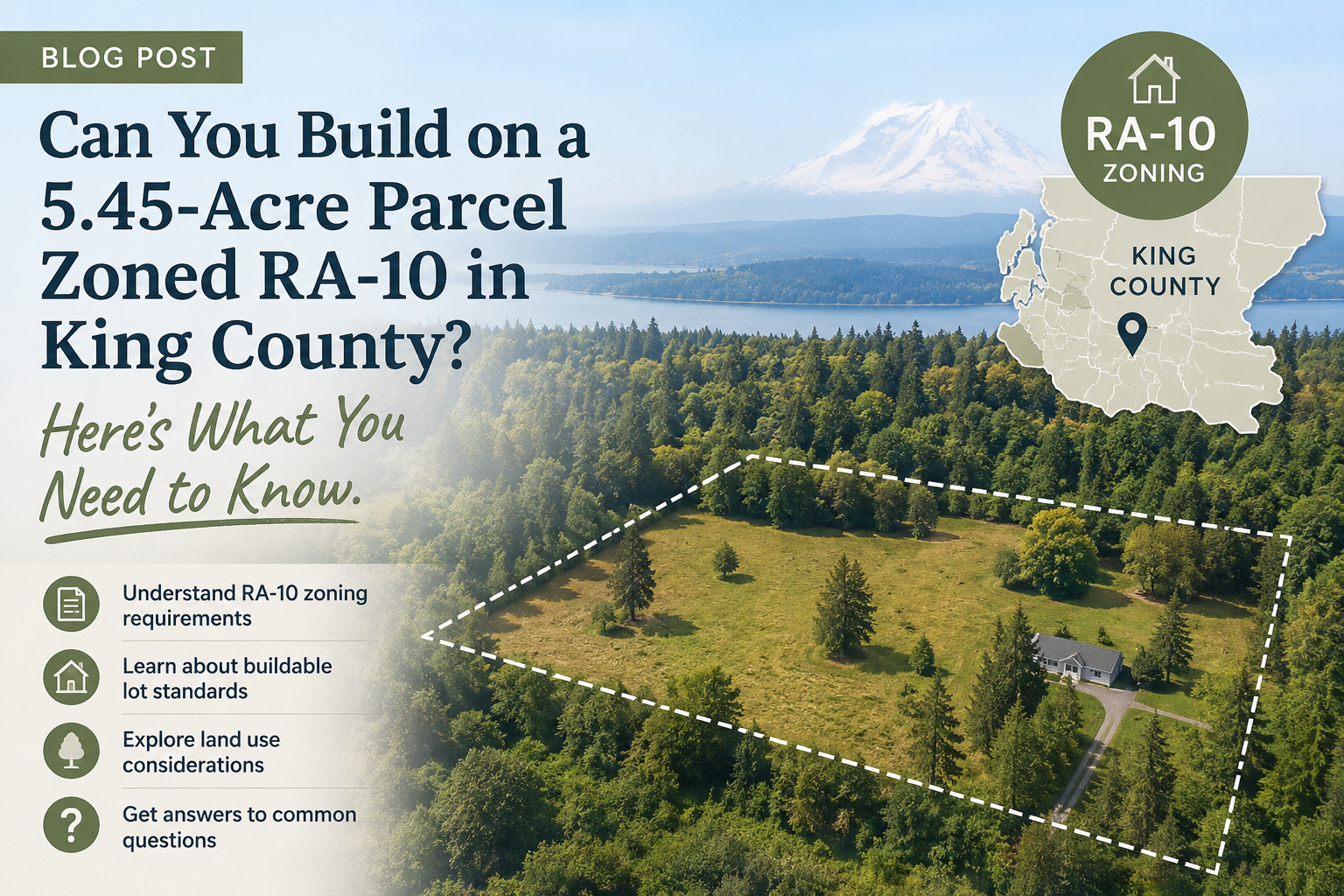
It's one of the most common questions I receive from buyers interested in rural land in the Snoqualmie Valley: "The listing says the property is zoned RA-10 and it's only 5.45 acres — does that mean I can't build on it?"
The short answer is: you probably can. But the longer answer requires understanding how King County zoning actually works in practice — and what other factors can make or break a rural parcel's buildability. As someone who specializes in rural and semi-rural properties right here in the Valley, this is a conversation I have regularly, and the details matter enormously.
Let me walk you through it.
What RA-10 Actually Means
RA stands for Rural Area — King County's zoning designation for unincorporated land outside the Urban Growth Boundary. The number that follows indicates the minimum lot size for new residential development. So RA-10 means one dwelling unit per 10 acres for newly created parcels.
The purpose of the Rural Area zone, as defined in King County Code, is to preserve long-term rural character, minimize conflicts with nearby agricultural or forest production districts, and limit residential densities to those compatible with rural service levels. In other words, this is King County's way of protecting the open, agricultural character that makes the Snoqualmie Valley what it is.
Other Rural Area designations you'll encounter in this market include RA-2.5 and RA-5, each with their own minimum acreage thresholds. RA-10 represents the most restrictive standard density tier in the rural residential category.
So Why Can a 5.45-Acre Parcel Still Be Buildable?
This is the part that surprises most buyers. A parcel that falls short of the 10-acre minimum is not automatically unbuildable — not by a long shot.
King County, like most jurisdictions, recognizes that vast amounts of rural land were subdivided and legally recorded before current zoning was adopted. If your parcel was properly platted or subdivided and has its own legal description on file with the county prior to the adoption of the applicable zoning code, it is considered a legally nonconforming lot. And under Washington State law and King County Code, a legally nonconforming lot retains the right to be developed with one single-family residence.
This situation is extremely common throughout the Snoqualmie Valley. Much of the rural acreage in this area was divided into smaller parcels decades before King County's modern zoning framework was put in place. A 5, 6, or 7-acre parcel zoned RA-10 is not unusual here, and many of them are perfectly buildable.
The critical question is not whether the parcel meets today's minimum acreage — it's whether the parcel was legally created. That's the first thing I verify when evaluating any rural land listing for a buyer.
The Real Obstacles to Buildability
Zoning is only the beginning of the conversation. In my experience working with buyers on rural parcels throughout the Valley, the factors below are far more likely to determine whether a parcel is actually buildable than the acreage alone.
1. King County's Critical Areas Ordinance (CAO)
This is the single biggest variable on rural land in King County — and it was just significantly updated. King County completed the first major revision of its Critical Areas Ordinance in nearly two decades, with the updated regulations adopted in late 2025. The updated CAO expands protections for wetlands, streams, riparian areas, fish and wildlife habitat conservation areas, frequently flooded areas, and critical aquifer recharge zones — all of which are abundantly present throughout the Snoqualmie Valley.
What this means practically: if your parcel contains any of the following, your buildable area may be dramatically reduced — or in some cases, eliminated entirely:
- Wetlands — and their expanded buffers under the updated CAO
- Streams and riparian areas — including buffer zones that can extend significantly back from the waterway
- Steep slopes — King County restricts development on slopes greater than 40 percent
- Flood hazard areas — particularly relevant given how much of the Valley floor sits within the 100-year floodplain
- Wildlife habitat conservation areas
- Critical aquifer recharge zones
A parcel that looks like 5.45 acres on a map can have a wetland, a stream buffer, and a steep slope consuming 4 of those acres, leaving you with a fraction of genuinely buildable land. I have seen buyers fall in love with a parcel only to discover after closing that the Critical Areas Ordinance left them with no viable building envelope whatsoever. That outcome is entirely avoidable with proper due diligence before you make an offer.
King County's iMap tool provides a useful starting point for identifying potential critical areas on any parcel, but it is not a complete picture. A private environmental consultant can perform a formal critical areas review that gives you a definitive answer.
2. Septic Feasibility
In rural King County, if you are not on public sewer — and on a 5.45-acre RA-10 parcel, you almost certainly are not — you must obtain King County Public Health approval for a septic system design before a building permit will be issued. No approved septic design means no building permit. Full stop.
Septic feasibility depends on soil composition, percolation rates, lot topography, proximity to wells and waterways, and the availability of adequate space for both a primary drainfield and a reserve drainfield area. In the Snoqualmie Valley, high water tables and clay-heavy soils in lower-elevation areas can create significant challenges. A parcel that looks ideal on paper may not perc.
I strongly recommend that any buyer of vacant rural land commission a septic site evaluation by a licensed engineer as a condition of the purchase and sale agreement — before closing, not after. The cost of this evaluation is modest compared to the risk of owning land you cannot build on.
3. Water Source
Unless public water is available — which is uncommon on rural RA-10 parcels — you will need a private well. Well viability depends on the local aquifer, neighboring well logs, and whether there is adequate physical separation between the proposed well and the septic system. Washington State requires minimum separation distances between these two systems, and on a smaller parcel with critical area constraints, finding compliant locations for both can be challenging. A well driller familiar with the Valley can provide a preliminary read on water availability before you commit.
4. Legal Access
Does the parcel have direct frontage on a public road, or does access cross another private property via an easement? If access is via an easement, it must be formally recorded, legally adequate for residential use, and maintained to a standard that allows emergency vehicle access. Easement issues are among the most common — and most overlooked — complications on rural land transactions. Confirm legal access before you make an offer.
The Pre-Purchase Checklist for Rural Land in King County
If you are seriously considering a rural parcel in the Snoqualmie Valley, here is the due diligence framework I walk every buyer through before we write an offer:
Zoning and legal lot status — Confirm the parcel is legally created and the nonconforming lot status is established in county records.
Critical Areas review — Run the parcel through King County iMap as a first pass, then engage an environmental consultant for a formal assessment if anything is flagged. Given the updated CAO, this step is more important now than ever.
Septic site evaluation — Commission a licensed engineer to assess soil conditions and identify a viable drainfield location. Make this a contingency in your purchase agreement.
Well feasibility — Review neighboring well logs through the Washington State Department of Ecology's well log database and consult a local driller.
Legal access confirmation — Verify that recorded, legally adequate access exists from a public road to the parcel.
Pre-application meeting with King County Permitting — This is one of the most valuable and underutilized steps available to buyers. King County Permitting offers pre-application consultations that give you an unofficial but informed read on your proposed development before you spend money on engineering. I recommend this for any vacant land purchase where buildability is not entirely clear.
The Bottom Line
A 5.45-acre parcel zoned RA-10 in King County is not disqualified from development simply because it falls short of the 10-acre minimum. If the lot was legally created, one single-family residence is generally permitted. The far more consequential questions involve critical areas, septic feasibility, water availability, and legal access — and those answers require real investigation, not assumptions.
Buying rural land in the Snoqualmie Valley is one of the most rewarding real estate decisions a buyer can make. The lifestyle, the space, the natural beauty — there is nothing quite like it. But it requires a level of due diligence that goes well beyond what is needed for a typical residential purchase. The stakes are higher, the variables are more complex, and the cost of getting it wrong is significant.
This is exactly the kind of transaction where having a hyper-local expert in your corner makes the difference — someone who knows this market, knows how to read a King County critical areas map, and knows the right questions to ask before you ever write a check.
Thinking about purchasing rural land in the Snoqualmie Valley? I would be glad to walk you through the due diligence process and help you find the right property — one that is genuinely buildable and right for your goals. Let's start the conversation.

Sandy Navidi
| Navidi Realty | TEC Real Estate
or another way