
Categories
Real Estate in Snoqualmie ValleyPublished July 1, 2026
Can You Get Affordable Homeowner's Insurance

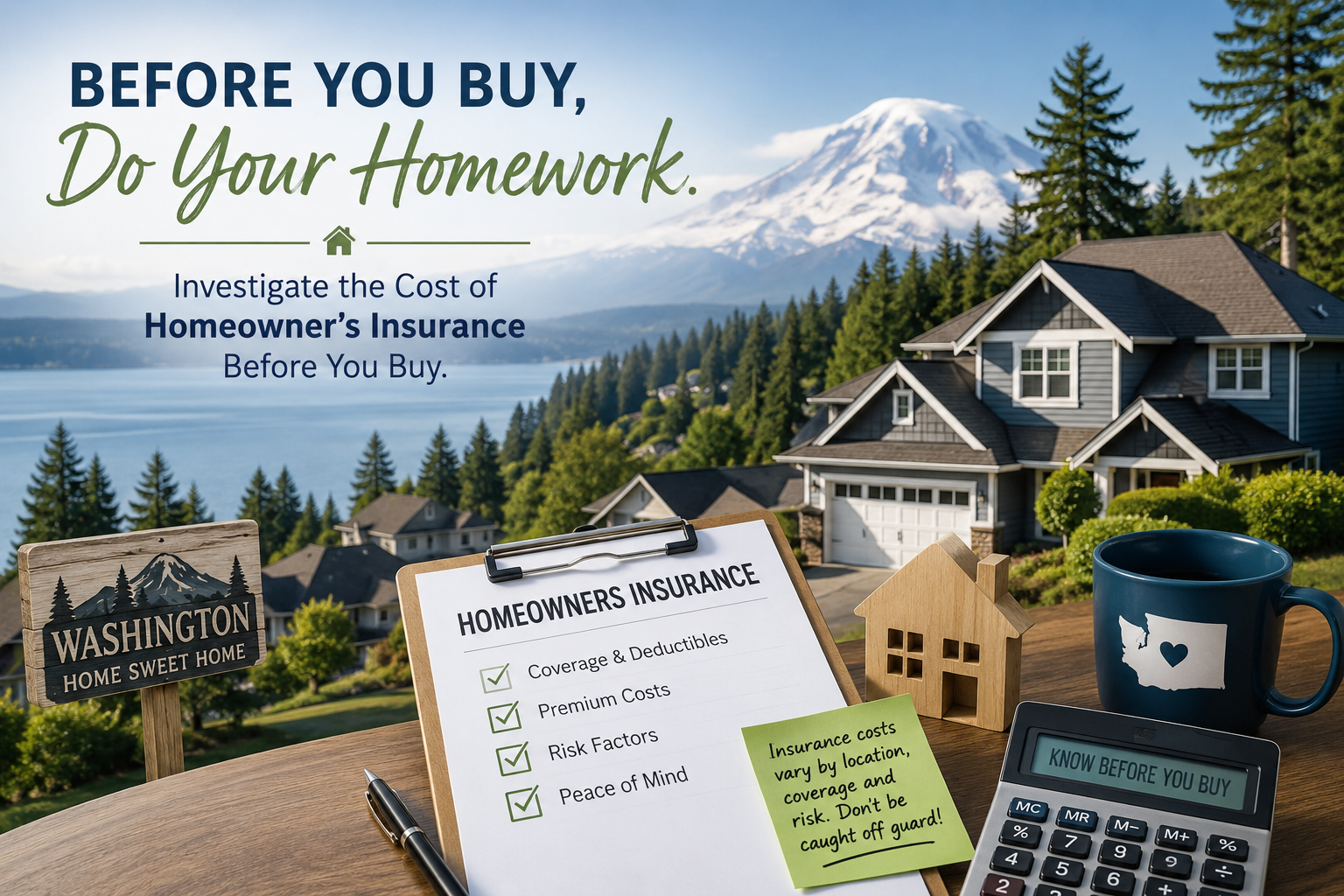
Can You Actually Get
Affordable Homeowners Insurance?
What every buyer needs to know before closing — especially in the Snoqualmie Valley, where flood plains, wildfire risk, and landslide terrain can make the insurance conversation more complicated than you'd expect.
Here is something I tell every buyer I work with, and I mean it as a professional warning, not a formality: do not assume you can afford to insure the home you're about to buy simply because the seller has been insuring it for years.
The insurance landscape has shifted dramatically. Premiums are rising faster than inflation, underwriting criteria are tightening, and certain risk categories that didn't matter much five years ago are now deal-breakers for some carriers. In the Snoqualmie Valley — where I focus my practice across North Bend, Snoqualmie, and Fall City — the terrain itself adds complexity. We have river systems that flood. We have forested hillsides with wildfire exposure. We have steep slopes. Buyers who don't ask the right questions before mutual acceptance can find themselves in an expensive, stressful scramble before closing.
This post is the guide I wish every buyer received on day one.
The seller's coverage tells you what they pay. It tells you nothing about what you'll pay — or whether you can get coverage at all.
The National Backdrop: A Market Under Pressure
To understand what's happening locally, you have to appreciate the scale of the national problem. Between 2021 and 2024, the average American homeowner's insurance premium rose by $648 — a 24% increase — reaching $3,303 per year. That's according to a major 2025 study by the Consumer Federation of America, which analyzed proprietary pricing data across every ZIP code in the country. Premiums rose in 95% of ZIP codes. One in three ZIP codes saw increases of more than 30%. And American homeowners collectively paid an estimated $21 billion more in premiums in 2024 than they did in 2021.
Zoom out further and the picture is even starker. Between 2020 and 2025, U.S. home insurance rates rose nearly 47% cumulatively, according to LendingTree. Rates peaked with back-to-back double-digit increases: 12.7% in 2023 and 10.4% in 2024. Even the recent "easing" to 6% in 2025 represents roughly triple the long-term historical norm.
Washington State is not the worst-hit market — that distinction belongs to states like Florida, Louisiana, Oklahoma, and Nebraska. But Washington did see double-digit rate increases in 2024. And within our state, the risk profile of your specific property now matters more than it ever has.
Why does this matter for buyers? Many lenders require proof of insurance before closing. If you find out two weeks before your closing date that your property is difficult to insure — or that coverage costs twice what you budgeted — you face a potential deal-disruption with no good options. Start shopping for insurance the moment you go under contract, not after the inspection.
Five Questions to Ask Before You Make an Offer
Every property carries its own risk profile. The questions below should be part of your due diligence — ideally answered before you have an accepted offer, or at a minimum before your insurance contingency deadline.
1. Wildfire Risk
Insurers now use sophisticated risk-scoring models that assign your home a wildfire score based on building materials, vegetation, proximity to forested land, and defensible space. In Washington, the number of insurance policy nonrenewals and cancellations has doubled since 2021 — from 11,763 to 24,106 — with wildfire risk scores cited as a contributing factor. Homes in Issaquah, Black Diamond, Enumclaw, and east King County generally carry higher scores. Even in North Bend and the Snoqualmie corridor, forested surroundings matter to underwriters.
2. Flood Risk
Standard homeowners insurance does not cover flood damage. This is one of the most important facts in real estate that buyers consistently underestimate. The Snoqualmie River floods regularly, affecting Fall City, Carnation, and the town of Snoqualmie. About 18% of Washington properties carry a greater than 26% chance of severe flooding within the next 30 years. If a property is in a FEMA-designated high-risk flood zone (Zone AE or A), your lender will require flood insurance. But even if you're in a lower-risk Zone X designation, claims still happen.
3. Landslide Risk
Earthquake coverage aside, landslide and earth movement coverage is typically excluded from standard homeowners policies. In the Snoqualmie Valley and surrounding hillsides, slope stability is a real concern — particularly after heavy rainfall or prolonged saturation. Steep parcels in North Bend, along the Mountain Loop Highway corridor, and in unincorporated King County may warrant a geotechnical review. If earth movement risk is present, you'll need to seek a separate endorsement or specialized policy — and not all carriers will write it.
4. Previous Claims History
Every property has an insurance claims record — called a CLUE Report (Comprehensive Loss Underwriting Exchange) — that documents all filed claims for the past seven years. Insurers pull this report when pricing your new policy. A property with prior water damage, fire claims, or mold remediation claims can be significantly more expensive to insure — or flat-out ineligible with standard carriers. As a buyer, you cannot request this report yourself; only the current owner can. Make requesting the CLUE report a standard part of your offer negotiations.
5. Replacement Cost Accuracy
Your insurer will want to know the estimated cost to rebuild your home from the ground up — not its market value, but its reconstruction cost. In recent years, construction costs have risen sharply due to labor shortages, material inflation, and supply chain disruptions. A $700,000 home in North Bend might carry a replacement cost of $500,000 or more. If your coverage limit is set too low, you'll be underinsured and will absorb the gap in a total loss. Always ask for a detailed replacement cost estimate before finalizing your coverage limits, and consider guaranteed replacement cost coverage when it's available.
The Seller's Coverage ≠ Your Coverage
A seller may have held a policy for 20 years with a grandfathered rate. They may have a different risk profile than you (some carriers rate based on owner history as well as property). They may have accepted coverage gaps you wouldn't. Their agent may not even serve your zip code anymore. Confirm insurability and get your own quotes independently, early in the process.
The Sticker Shock Is Real
I have sat across the table from buyers who confidently budgeted $150 per month for homeowners insurance on a purchase in our area — and received quotes of $300 to $400 per month or more, once flood, wildfire exposure, and property characteristics were factored in. That's not an outlier anymore. It's increasingly common.
Nationally, homeowners who bought their policies in 2021 were paying nearly 69% more by their 2024 renewal — an average of $865 more per year than just three years earlier. When you layer on Washington State's own double-digit increases, rural and semi-rural properties that were easy to insure a decade ago have become much harder to budget for today.
Practical tip: Treat insurance quotes the same way you treat inspection reports. Get them early. Get more than one. And factor the annual premium into your total cost of ownership before you remove contingencies — not after.
Flood Insurance: Don't Wait to Be Told You Need It
This is the area where I see the most buyer confusion, and frankly the most risk.
Let me be direct: if you are buying in Fall City, North Bend, Snoqualmie, or Carnation — communities that sit alongside or near the Snoqualmie River — you need to think carefully about flood insurance regardless of whether your specific parcel is inside the official floodway or flood plain.
Here's why: FEMA's flood maps, while useful, are not infallible. They're updated infrequently and don't always reflect real-world hydrological behavior, especially as rainfall patterns shift and development upstream changes water flow. A property mapped in Zone X (moderate to low risk) can still flood. In fact, roughly 20% of all flood insurance claims nationwide come from properties outside high-risk flood zones.
The good news is that flood insurance is available even if you're not required to carry it. The National Flood Insurance Program (NFIP) — backed by FEMA — offers policies to virtually any property owner, regardless of flood zone designation. Premiums for lower-risk zones are substantially less expensive than those for high-risk areas. Private flood insurance options have also expanded significantly and can sometimes offer broader coverage or faster claims processing than the NFIP.
Know your zones. Zone AE or A = lender-required flood insurance. Zone X = optional but worth serious consideration. Zone D = unmapped and uncertain, which can actually carry higher premiums because the risk is unquantified. If you don't know which zone your potential purchase sits in, I can walk you through the FEMA Flood Map Service Center for your specific parcel.
The Snoqualmie River's behavior is well-documented. It rises fast during heavy rain events and snowmelt events, and it has overtopped its banks in ways that affected properties well outside the formally mapped floodway. Buyers who do not ask this question — and who assume they're safe because they're "not in the flood plain" — are operating on incomplete information.
Washington's Safety Net: The FAIR Plan
If you find a property that standard insurers won't cover — whether because of wildfire risk scores, claims history, or location — you're not entirely without options. Washington State operates a FAIR Plan (Fair Access to Insurance Requirements) that provides coverage for hard-to-insure properties. The FAIR Plan is a last resort, not a preferred choice; coverage tends to be more limited and more expensive than standard market policies. But it exists, and buyers should know about it.
The Washington Office of the Insurance Commissioner is also actively working to bring greater transparency to wildfire risk scoring — including proposed legislation that would require insurers to disclose their risk scores and the methodology behind them. That's a meaningful development, but it hasn't resolved the underlying market tension between insurer risk management and homeowner affordability.
What You Can Do Right Now
- Start shopping for insurance quotes as soon as you have a signed Purchase and Sale Agreement — before your inspection, not after.
- Request the seller's CLUE report as part of your due diligence. A seller who refuses to provide it is sending you a signal worth investigating.
- Check your property's flood zone at msc.fema.gov using the exact parcel address — and don't stop there. Ask a local insurance agent what they've seen happen on nearby properties.
- Ask your insurance agent directly: "Is this property in a wildfire risk zone, and does that affect coverage or pricing?" Don't assume the absence of recent fires means low risk.
- Get a replacement cost estimate, not just a market value comparison. These numbers are increasingly divergent in our area.
- Consider bundling. Combining homeowners and auto insurance with the same carrier often produces meaningful discounts — sometimes 10–15%.
- If you're purchasing a property on a slope or hillside, ask about earth movement exclusions explicitly. Know what you're not covered for.
- If standard carriers decline your property, contact the Washington FAIR Plan: 425-745-9808.
My Bottom Line
Homeowners insurance used to be the part of a real estate transaction that required about thirty minutes of attention. That era is over. In today's market — and especially in the Snoqualmie Valley, where the natural environment creates real and measurable risk in multiple categories — insurance is a material factor in whether a transaction makes financial sense for a buyer.
The question isn't just "can I get insurance?" It's "can I afford the insurance this property actually requires?" Those are two very different questions, and getting the answer to the second one requires starting early, asking the right questions, and working with an agent who understands the local landscape — both figuratively and literally.
If you're considering a purchase in North Bend, Snoqualmie, Fall City, or anywhere in the greater Snoqualmie Valley, I'm happy to talk through the insurance questions specific to any property you're evaluating. It's part of what I do as your hyper-local advisor — not just getting you into a home, but making sure you understand exactly what you're buying into.

Sandy Navidi
| Navidi Realty | TEC Real Estate
or another way