
Categories
Buying a Home in Snoqualmie Valley, Real Estate in Fall City, Real Estate in North Bend WA, Real Estate in Snoqualmie, Real Estate in Snoqualmie ValleyPublished November 4, 2026
What To Know About Living On A Group B Well In Snoqualmie Valley

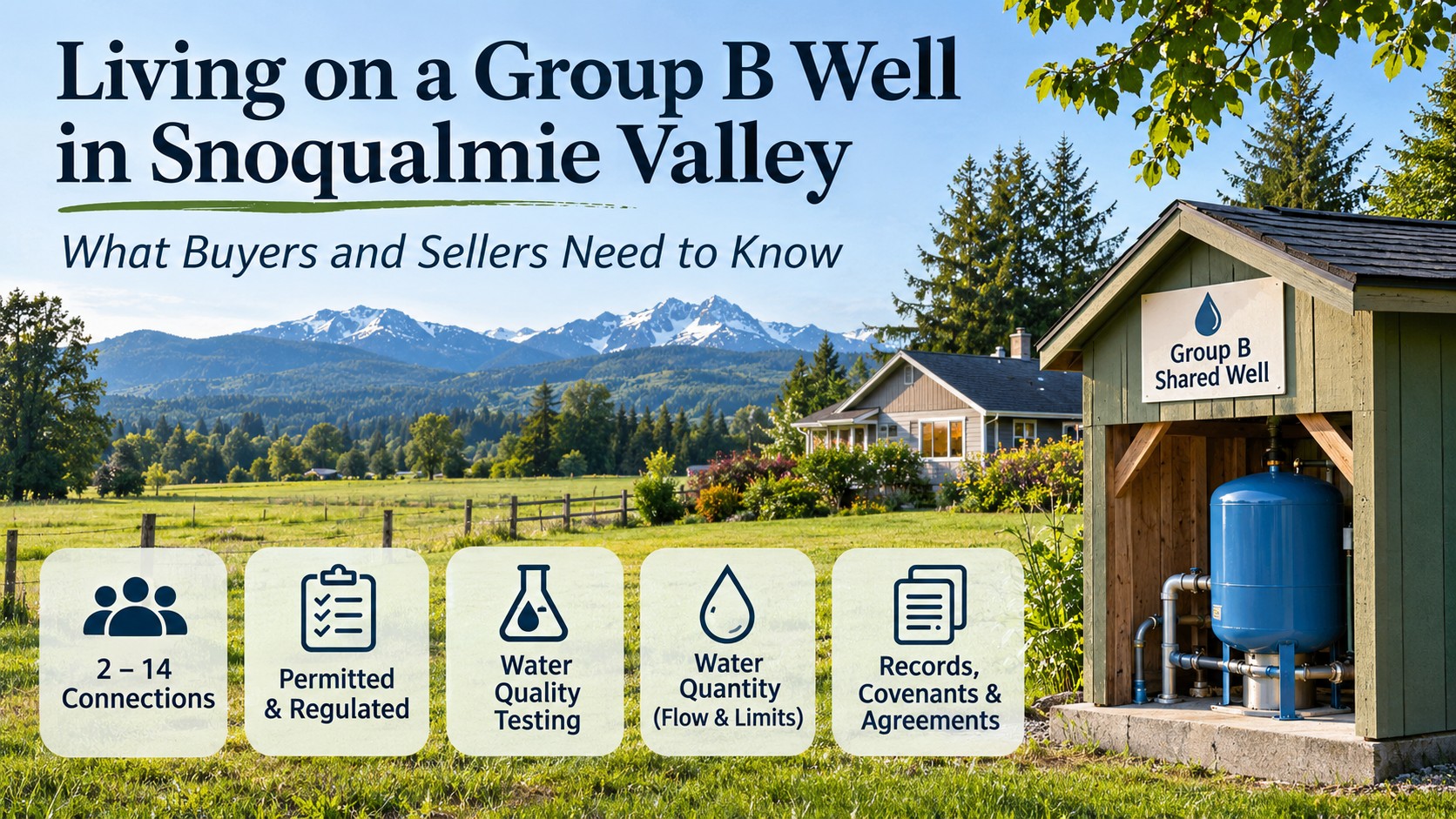
Living on a Group B Well in Snoqualmie valley: What Buyers and Sellers Need to Know
If you have spent any time house-hunting east of Lake Washington, you have probably seen it in a listing: "Shared well," "Group B water," or "community well." Many buyers skim past it. Smart ones stop and ask questions. A Group B well can be a perfectly good water source for a rural home, but it comes with shared responsibilities, rules, and paperwork that a standard private well does not. Here is what I walk my clients through before they write an offer.
What Exactly Is a Group B Water System?
Washington sorts drinking water systems into three tiers. A private (individual) well serves a single home. A Group A system is a larger public system, generally 15 or more connections. A Group B system sits in the middle: it serves 2 to 14 connections and fewer than 25 people per day.
Here is the detail that surprises people: in King County, any water system serving two or more parcels must be permitted as a Group B public water system. That means a well shared by just two neighbors is regulated as a public water system. The Washington State Department of Health will permit a Group B for two parcels by designing it for four connections, two for each parcel.
Who Regulates It?
The regulatory picture has a few layers, and knowing who does what helps you find records fast:
- Washington State Department of Health (DOH) permits all new Group B systems. The Office of Drinking Water's Northwest Regional Office reviews and approves the designs.
- Public Health – Seattle & King County conducts the well site inspection, surveying the proposed location for potential sources of contamination. It inspects the site but does not issue the well site approval.
- A licensed well driller must construct the well in compliance with chapter 173-160 WAC.
- Recorded covenants are required, signed and notarized, so the water system obligations run with the land and follow the property to the next owner.
Water Quality: The Standards That Matter
This is where the date of the system's approval matters.
- Arsenic: The 10 parts per billion (ppb) standard applies to new or expanding Group B systems approved after January 1, 2014. Systems approved before that date may exceed 10 ppb. They are not out of compliance, but the Department of Health notes owners may want to take extra precautions.
- Nitrate: If a sample comes back above 10.0 parts per million, the system owner must notify users immediately.
- Coliform bacteria: If a sample shows E. coli, users must be notified immediately.
- No treatment shortcut for new systems: Since January 1, 2014, new Group B systems must meet primary drinking water standards without treatment.
Testing and Record-Keeping: What the Operator Must Do
For most Group B systems in King County, routine monitoring means one bacteriological sample every year and one nitrate sample every three years. The system operator (called the "purveyor") is also responsible for:
- Sending sample results directly to Public Health. Don't assume the lab will do it.
- Following up with additional testing after any unsatisfactory result.
- Notifying Public Health and every user of the system when a sample fails.
- Enforcing a protective radius around the wellhead with all users, under King County Board of Health Title 12.
- Keeping the system maintained, either personally, through another user, or by hiring a water system maintenance company.
- Keeping records: bacteriological analyses for at least five years, system evaluations for ten years, and chemical analyses such as nitrate tests for as long as the system operates.
If the owners don't want to do this themselves, the Department of Health maintains a list of approved Satellite Management Agencies that can handle sampling, repairs, maintenance, inspections, and project coordination.
The Water Quantity Question
Most Group B wells in rural East King County are "permit-exempt," meaning they operate under the group domestic exemption in RCW 90.44.050 rather than holding a traditional water right. That exemption is capped at 5,000 gallons per day.
For newer wells, the rules are tighter. For permit-exempt wells installed after January 18, 2018, King County requires:
- Domestic use only, limited to a maximum annual average of 950 gallons per day per connection, up to 5,000 gallons per day per well
- A $500 fee per building permit application
- A copy of the Department of Ecology well report
- A recorded legal document noting the limits
- A reduction to 350 gallons per day, indoor use only, under a declared drought emergency
For context, Ecology's planning assumption is about 60 gallons per person per day of indoor use. For a typical rural household, 950 gallons a day is workable, but big irrigation plans, a hobby farm, or an ADU may stretch it. Ask early.
You don't want to just have clean drinking water, you want to have ENOUGH of it as well. This is commonly referred to as the "flow" and is measured in gallons per minute. It measures the water pressure. Imagine that someone is showering, the washing machine is going, as is the dish washer. If someone turns on the hose outside to wash a car - what happens to the pressure? can you get enought water, under demand, to meet the need?
Why Connection Count Matters
A Group B system cannot serve more connections than its original approved design without going through an official expansion process. If a seller says "we could always add one more house," don't take that on faith. Ask for the paperwork. Evidence of approved connections can include approval letters, approved designs, a water use agreement, informational notices on the property title, and a Certificate of Water Availability from the system's purveyor.
There is also a practical wrinkle for anyone planning a septic project: using a Group B system for an onsite sewage system application requires satisfactory water quality test results within the last year.
Where to Find the Records
For Group B systems King County originally approved before 2011, the county keeps historic records, and its Septic and Group B Records search is online. Those historic files are filed by water system name, not by street address, so you will want to know what the system is called. these can easily be found through "imap" in the King County Parcel Viewer.
My Buyer Checklist for Any Group B Property
Before I let a client remove a water contingency, I want answers to these questions:
- Is there a Water System ID and an approval letter? Is the system approved and in good standing?
- Who is the purveyor, and are they responsive?
- How many connections are approved, and how many are actually in use?
- Is there a written shared well agreement covering maintenance costs, repairs, power, decision-making, and what happens if someone doesn't pay?
- Are the covenants recorded on title?
- What do the last several years of coliform and nitrate results show? Have there been any unsatisfactory samples?
- When was the system approved? Before or after January 1, 2014 (arsenic standard)? Was the well drilled after January 18, 2018 (gallon-per-day limits)?
- What is the pump, pressure tank, and well house condition and age? Shared equipment fails at the least convenient times.
- Is there a reserve fund, or will a $5,000 pump replacement become a neighborhood argument?
For Sellers: Get Ahead of It
If you own a home on a Group B well, a little preparation makes your listing smoother. Pull your approval letter, covenants, shared well agreement, and recent water test results into one folder. Make sure your sampling is current and results have been submitted. Have a reputable well company pro actively inspect the well, the pump, the entire system. If there are issues? get ahead of it. Buyers who see organized records tend to feel confident rather than nervous, and that protects your price and timeline.
The Bottom Line
A Group B well is not a red flag. It is a known quantity when you understand how it is permitted, who is responsible for it, and what the paperwork should say. The buyers who run into trouble are the ones who learn about the system after closing. Well water is significantly cheaper that a public water source - if well maintained, well water can be a feature, not a flaw.
Thinking about buying or selling a home with a shared well in East King County? I'm happy to review the water system documents with you before you commit.

Sandy Navidi
| Navidi Realty | TEC Real Estate
or another way